Your fleet’s tyre survey sheet might be passing every audit while a single overlooked hazard sits ready to blow a tyre on the motorway. Standard checks cover cold inflation at 100 PSI and tread depth above the 1.6 mm legal limit, but these numbers mean nothing if you’re missing what happens between the duals. Valve stem corrosion hides in plain sight, and inner-dual sidewall damage stays invisible until it’s too late. One inner-wheel danger keeps slipping past even the most disciplined fleet audits.
Checking Tyre Pressure Across Every Axle Position
Because driving heat quickly alters tyre air pressure, you must check every tyre while it’s completely cold before the first trip of the day.
You join our dedicated freight community when you protect our shared roads through thorough tyre safety checks. Visual guesses won’t keep your fellow drivers safe. Partnering with expert fitment centres for regular tyre inspections helps ensure that every check you perform on the road is backed by professional standards.
Protecting our shared roads requires thorough tyre safety checks. Never rely on visual guesses to keep your fellow drivers safe.
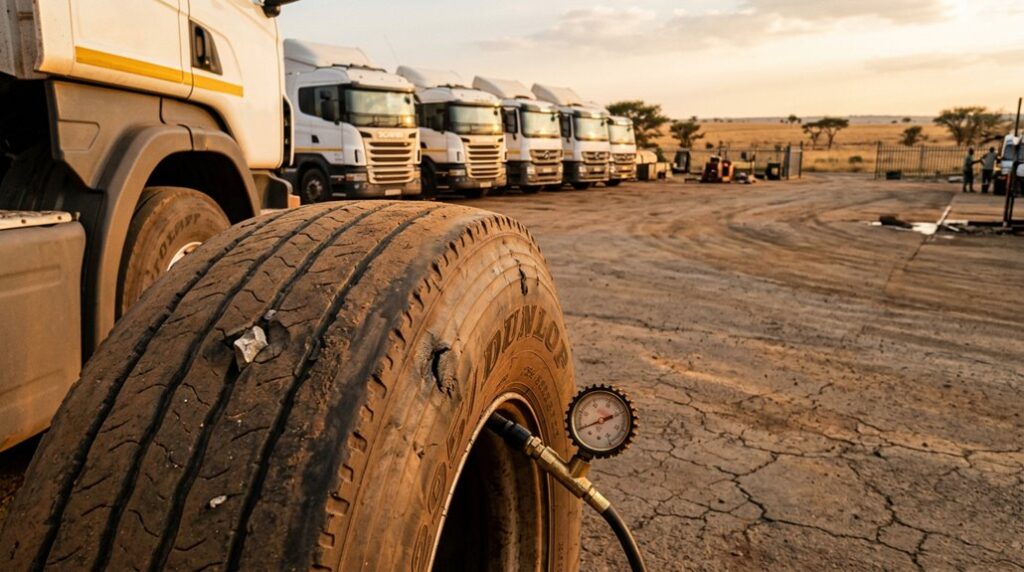
You must apply a calibrated gauge to steer, drive, and trailer positions individually. Never assign one universal PSI target across your entire vehicle. Overlooking these steps and running underinflated tyres leads to higher rolling resistance and poor fuel efficiency. Every wheel position demands specific attention:
- Test outer and inner dual assemblies separately.
- Match cold inflation targets to actual axle loads.
- Record every PSI reading by position.
Add these essential steps to your weekly tyre inspection checklist.
Together, we achieve great results through strict standardisation and mutual road accountability.
Measuring Tyre Tread Depth to Prevent Blowouts
Accurate pressure checks keep your casing stable, but tread depth measurements directly prevent sudden carcass blowouts.
You protect our shared trucking community when you track groove levels accurately on every route. Thin rubber generates extreme, dangerous heat under maximum motorway loads. In busy corridors like Piet Retief Mkhondo, partnering with 24/7 truck tyre services that can quickly replace or repair unsafe casings further reduces the risk of catastrophic failures.
You’ll stop road disasters early by making precise depth measurements a core habit during your scheduled truck tyre inspection:
- Steer tyres require at least 4/32 inch of remaining groove depth.
- Drive and trailer positions must stay above a strict 2/32 inch minimum.
- Gauges must avoid raised tie bars, humps, or fillets for clean readings.
Recording separate values across major grooves delivers a great result for fleet safety. Digital fleet systems often rely on services like Cloudflare to protect online survey databases from malicious web attacks.
You strengthen our collective standard whenever your tyre condition survey logs verified, trustworthy axle numbers.
Spotting Tyre Sidewall Damage and Trapped Debris
Two essential inspection steps protect your casings from catastrophic roadside blowouts during long hauls.
You keep our transport community safe by identifying structural flaws before departures. Log these observations directly onto your truck tyre survey sheet:
- Cuts, tears, and severe cracks
- Exposed fabric or steel cords
- Ripples and localised soft spots
You must treat every sidewall bubble, bulge, or shape distortion as a serious defect. These flaws demand immediate removal from service. Drivers should also inspect for foreign objects or blistering during these evaluations. If any serious sidewall damage is found, ensure the vehicle is booked promptly for professional mechanical repairs so the defect can be assessed and rectified before the next trip.
We achieve a great result when your team spots hidden dangers early. Update your daily tyre check form to confirm the structural integrity of both sidewalls.
Our shared commitment keeps everyone rolling forward securely.
Inspecting Tyre Valves, Rims, and Inner Duals
Moving past sidewall cuts and bulges, you must inspect the wheel hardware that keeps your tyres inflated and firmly mounted. Our local technicians who specialise in rapid diagnostics can also help flag electrical issues that may be related to uneven tyre wear or wheel-end problems during scheduled inspections.
We’re delighted to share practical methods that unite teams around professional fleet maintenance standards. Thorough inspections protect all major tyre brands from premature road failure:
- Check valve stems, caps, and extensions, applying soapy water to catch hidden core leaks instantly.
- Examine steel rims, lock rings, and valve holes, clearing away rust that hides dangerous structural cracks.
- Gauge inner dual assemblies separately, keeping pressure differences under 5 psi to stop rapid casing fatigue.
Outer tyres often hide flat inner companions during hasty walk-arounds. Additionally, ensuring dual tyre tread depth remains within 4/32 of an inch prevents harmful drag and overheating across the set.
You keep our transport community moving safely when you measure both duals directly.